STRENGTHS
Learning at Matsumura Lab That Supports Your Career After Graduation
-

Developing communication skills
in an international environmentBy working on research projects together with international students, you can gradually develop communication skills that will be useful in your future career.
-

Balancing research and
job hunting at your own paceMatsumura Lab offers an environment where you can adjust the balance between research and job hunting according to your own pace, making it easier to manage both without unnecessary pressure.
-

Research experience that
leads to diverse career pathsThe ways of thinking and technical skills developed through research at Matsumura Lab can be applied to a wide range of career paths, beyond specific fields.

Career Paths
Hitachi, Ltd / Hitachi High-Tech Corporation / Earth Corporation / serotec Co,.Ltd. /
KEF Corporation / Denka Company Limited / NOK CORPORATION / FUKOKU Co., Ltd. /
ASAHI RUBBER INC. / TERUMO CORPORATION / SHIBUYA CORPORATION /
Sekisui Polymatech Co., Ltd. / CoorsTek GK / ADVICS Co., Ltd. / Panasonic Corporation /
ASAHI INTECC CO., LTD. / Nifco Inc. / KYB Corporation / NOF CORPORATION / SEIREN CO., LTD. /
Nitta Gelatin Inc. / Komatsu Ltd. / NAKASHIMA HEALTHFORCE CO., LTD. / Carlit Co., Ltd. /
Unipres Corp , etc.

Gaining Hands-On Experience Through Collaboration with Industry
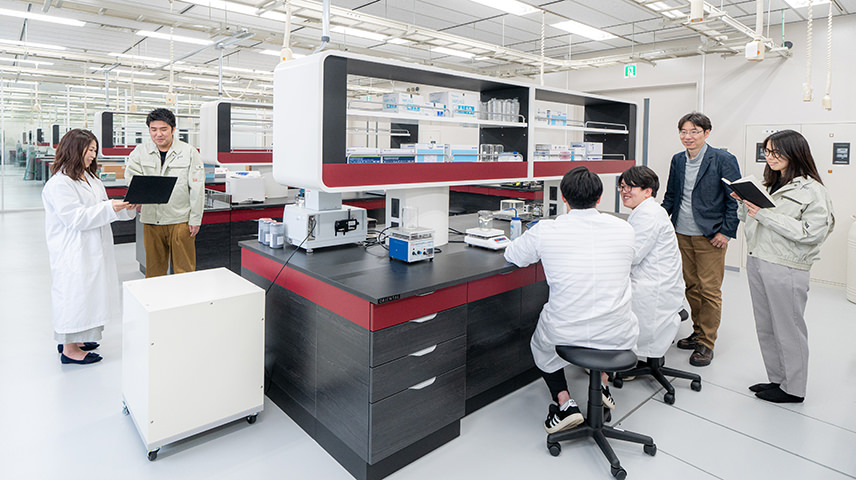
At eMEDX, where Professor Matsumura serves as the site director, open innovation through collaboration with industry partners is actively promoted. Students are also encouraged to take part in joint research projects with companies, providing opportunities to gain experience close to real-world research environments.

Graduates of Matsumura Lab have pursued careers across a wide range of industries, including medical device manufacturers,
pharmaceutical companies, chemical manufacturers, the automotive industry, and food companies.
Their roles are diverse, such as research and development, engineering, and technical sales,
and some graduates have chosen to pursue careers in academia as researchers.
STUDENT VOICES
An International Research Environment to Naturally Build English Skills
-
Being surrounded by international students, communicating in English, and spending time immersed in different cultures has been helpful for me after starting my career. I also feel that this experience can be a positive point to highlight during the job-hunting process.

-
Making an effort to communicate with international students in the lab—not only in English—can be a significant advantage not only for foreign-affiliated companies but also for Japanese companies operating on a global scale, and it forms a foundation for personal growth.

-
I am currently working overseas, and I feel that the communication skills I developed through interactions with international students in the lab are being applied in my work.

Balancing Research and Job Hunting at Your Own Pace
-
You do not need to decide on a specific career field at the outset of your job search. It is not too late to explore different industries and companies while engaging in research. Life in the lab at Matsumura Lab can be a fulfilling experience, and we encourage students to broaden their perspectives and move forward with their job search alongside their research activities.
-
In addition to information sessions, the university provides extensive career support, including résumé reviews and mock interviews conducted by professional consultants. This support system allows students to balance their research activities with job hunting and enjoy a fulfilling student life.

-
In addition to being understanding of job-hunting activities, the lab generally allows students to take the lead in deciding how they conduct their research. Because of this flexibility, I feel it is relatively easy to adjust priorities—for example, focusing more on job hunting during certain periods rather than research.

Research Experience That Leads to Diverse Career Paths
-
Although I joined a company in a field different from my research area, I work in production engineering, and the way I approached research aimed at technological development, as well as how I planned experiments, has been extremely useful—even in a different field.
-
In research and development roles, while each company has its own culture and unique approaches, the synthesis techniques and evaluation and analysis methods learned in the lab are consistently required and prove to be valuable.
-
By organizing the background and objectives of my research and clearly articulating the skills I developed in graduate school, I felt that I was able to communicate my ideas more accurately.

Voices from Graduates Active Across a Wide Range of Fields
-
Voice 01 Developing the Ability to Communicate Through Everyday Interactions with International Students
Being surrounded by international students, communicating in English, and spending my days immersed in different cultures has been more helpful to me after starting my career than during job hunting itself.
I also feel that these experiences can be a positive point to highlight during the job-hunting process.
Although there are no colleagues at my company who do not understand Japanese, there have been situations where I needed to work with people outside the company who do not speak Japanese. In those moments, rather than giving up because I lacked confidence in my English, I was able to communicate what I wanted to say—even with imperfect English—which I now feel was a valuable experience.
While there may not be many opportunities for my graduate research to directly connect to my current job, I believe that the five years I spent in an environment that is hard to find elsewhere have been truly beneficial. -
Voice 02 Building Confidence Through an International Environment and Flexible Research
One of the things that surprised me most after joining this lab was the diversity of nationalities among the researchers. English is used on a daily basis, and discussing research with peers from different backgrounds greatly broadened my perspective. I feel that the opportunity to conduct research in such an international environment is one of the unique strengths of this lab.
I was also deeply impressed by the high level of flexibility in using research equipment at my own pace. Having an environment where I could actively use the facilities according to my research theme felt particularly well-supported, even within Japan. Being able to pursue the research I wanted through repeated experimentation, in a relaxed and self-directed manner, has given me great confidence.
JAIST is an ideal place for students who want to take initiative in their work. For those who wish to deepen their research or grow in an international environment, I believe it offers valuable opportunities. -
Voice 03 Research Thinking That Remains Valuable Across Different Fields
Although I joined a company in a field different from my research area, I work in production engineering, and the approach to research aimed at technological development, as well as the way I plan experiments, has been extremely useful—even in a different field. I am currently working overseas, and I feel that the communication I had with international students in the lab is also being applied in my professional work.
Rather than deciding on a specific career field too early, it is not too late to explore different industries while continuing your research.
Life in the lab at Matsumura Lab can be a fulfilling experience, and I encourage students to broaden their perspectives and move forward with their job search alongside their research activities. -
Voice 04 Balancing Job Hunting with Support from Alumni and Career Guidance
After completing my master’s program at JAIST, I joined a local manufacturing company. At JAIST, companies regularly hold joint information sessions on campus, providing opportunities to speak directly and in depth with company representatives.
In my case, after attending group explanations at company booths, I was able to have one-on-one conversations with company representatives to learn more details. This gave me the impression that many companies have a strong interest in students from JAIST. A wide variety of companies and industries show interest in JAIST students, and well-known companies that many people recognize also participate in these information sessions.
It is also common for alumni of JAIST to take part in these events. This makes it easy to casually ask about student life, concerns related to job hunting, and the nature of work after joining a company.
In addition to information sessions, the university provides extensive career support, including résumé reviews and mock interviews conducted by professional consultants. This support system makes it easier to balance research activities with job hunting and to enjoy a fulfilling student life.
If you are considering further study, I encourage you to consider JAIST as one of your options. -
Voice 05 Unique Research Themes and Advanced Facilities as Strengths for Job Hunting
・Functional polymers are one of the research areas that attract particular attention from chemical and medical-related companies. At the company where I currently work, researchers actively participate in academic conferences and continuously keep track of trends in this field. As a result, there are quite a few people within the company who are familiar with Professor Matsumura. While receiving a job offer based solely on the name of a lab is never the case, I believe this lab has a solid track record that is recognized by industry. If you are interested in this field, choosing this lab would not be a disadvantage.
・Cryopreservation of cells is also one of the essential technologies supporting the development of the medical industry. However, very few universities actively conduct research in this area. In fields where similar research topics are common, it can be difficult to leave a strong impression during job hunting. By contrast, working in a research area that is less common can become a strong advantage. At Matsumura Lab, it is possible to engage in research that is not easily found elsewhere.
・At JAIST, there are many state-of-the-art research instruments that are rarely available even at large corporations. While this depends on the research topic, the themes studied at Matsumura Lab often provide opportunities to work with such advanced equipment. With sufficient initiative, students can conduct highly advanced research that may not be possible in other environments. During job hunting, I was surprised by how often companies asked about the types of equipment I had used, so experience in such an environment may work to one’s advantage.
・In addition to being understanding of job-hunting activities, the lab generally allows students to take the lead in deciding how their research is conducted. Because of this flexibility, I feel it is relatively easy to adjust priorities—for example, focusing more on job hunting during certain periods rather than research.
・I personally focused my job search on chemical and medical-related manufacturers from the beginning, so I cannot speak about other industries. However, for chemical and medical companies, every employer showed interest in my research. At the very least, I was never unsuccessful in technical interviews where I was asked to present my research. If you are considering a career in a similar field, I believe this lab is a very good match.
-
Voice 06 A Valuable Research Environment Where You Can Become Comfortable with English
During my job search, I chose companies based on the idea of wanting to enrich the lives of many people, both in Japan and abroad. Since communication in the lab was conducted in English on a daily basis, I did my best to use English for conversations ranging from everyday topics to technical discussions, even though English was not my strong point. Through this experience, I expressed to interviewers that I believed I could work effectively in a global environment.
Looking back, I now feel that having an environment where English is used on a daily basis is truly valuable. This may not be the best way to put it, but I feel that my so-called “fear of English” has gradually disappeared. -
Voice 07 Building a Foundation for Your Career Through Interaction with International Students
In research and development roles, while each company has its own culture and unique approaches, the synthesis techniques and evaluation and analysis methods learned in the lab are consistently required and continue to be valuable.
In addition, making an effort to communicate with international students in the lab—not limited to English—can become a significant advantage not only in foreign-affiliated companies but also in Japanese companies operating on a global scale, and it forms a foundation for personal growth.
In today’s environment, where it is no longer uncommon to change employers over the course of a career, I feel that the value of what can be learned at Matsumura Lab is becoming increasingly significant. -
Voice 08 Starting Early: Tips for Job Hunting and Making Use of Available Resources
I recommend starting your job search as early as possible.Participating in internships can be helpful when moving forward with job hunting.
If there are companies you are interested in among those eligible for university recommendations, making use of the university recommendation system is also one option to consider.
If you have not yet decided on specific companies you wish to apply to, the career services office provides information on the employment destinations of past graduates, which may serve as a useful reference.
I sincerely wish you success in finding a position with a company that matches your goals. -
Voice 09 Strong Communication Skills and a Broad Perspective Strengthen Job Hunting
While pursuing a career in research and development, there were two things I found particularly important during my job search.
The first is the ability to explain my research in a way that is easy to understand, even for people outside my field of expertise. By organizing the background and objectives of my research and putting into words the skills I developed in graduate school, I felt I was able to communicate my ideas more accurately.
The second is looking at companies without limiting myself to a specific industry. Research topics at university do not necessarily need to match a company’s research themes exactly, and by learning about a wide range of companies, the chances of finding a career path that suits you can increase.
Through internships, I was also able to learn not only about research content, but about the workplace atmosphere and the people working there, which was a great help in moving forward with my job search in a positive way. In addition, faculty members provided feedback on my application documents, including my entry sheet. -
Voice 10 If You Love Research, Consider the Challenge of Pursuing a PhD
After completing my master’s program, I decided to continue on to a doctoral program. While my original plan after obtaining a PhD was to join a company, I was also interested in the academic world.
In fact, after earning my degree, I spent one year conducting research at Matsumura Lab as a postdoctoral researcher before moving to another university as a specially appointed assistant professor.
To be honest, I did feel some uncertainty about remaining in academia. However, when I considered that life only comes once, I felt it might be worth taking on the challenge. Above all, what motivated me most was my love for research and my passion for chemistry.
Of course, I think most students complete a master’s program and then enter the workforce. But if you have even a slight interest, or if you truly enjoy research, I believe it is worth considering this path. At JAIST, the environment is well prepared, and I feel that strong support is available.
If you are interested, I encourage you to start by visiting the lab. Wanting to do this research or having an interest in this field is reason enough to begin.

Q&A
-
Q.1 What career paths are available after graduation?
After completing a master’s degree, many graduates pursue research positions at chemical manufacturers, medical device companies, or precision equipment manufacturers. For those who complete a doctoral degree, some choose to work as postdoctoral researchers at universities and aim for careers in academia, while others go on to research positions in industry.
-
Q.2 How many students advance to a doctoral program?
At Matsumura Lab, a relatively high number of students choose to advance to a doctoral program. In particular, most international students express an interest in continuing to the doctoral level. In addition, seven Japanese students have advanced to a doctoral program in the past.
-
Q.3 What types of companies do graduates join?
Graduates have joined a wide range of companies, including chemical manufacturers, medical device companies, automotive-related manufacturers, and precision equipment manufacturers. For more detailed information, please refer to the “Career Paths of Our Graduates” section above.
-
Q.4 Is it possible to find a job after completing a doctoral program?
Yes. In recent years, an increasing number of companies have been seeking candidates with doctoral degrees. Many graduates who completed a doctoral program in this lab have gone on to take research positions in industry.
-
Q.5 Is it possible to conduct research or work overseas?
Yes, it is possible. In particular, obtaining a doctoral degree can expand opportunities and improve career prospects abroad. One of the strengths of JAIST and Matsumura Lab is that students can develop a global perspective while conducting research within the lab.
USEFUL RESOURCES
Career and Employment Page
Information on job-hunting support, career-related events, and the career paths of graduates is provided.
Matsumura Lab Interview Feature Page
A collection of interviews highly recommended for students considering JAIST,
featuring candid conversations between students and faculty members.
JAIST Prospective Students Website
Content for prospective students, including information on entrance examinations and
the academic fields available at JAIST.
Graduate School Consultation Anytime, Anywhere
Information on a program that welcomes individual visits for those considering or
interested in applying to our university.

